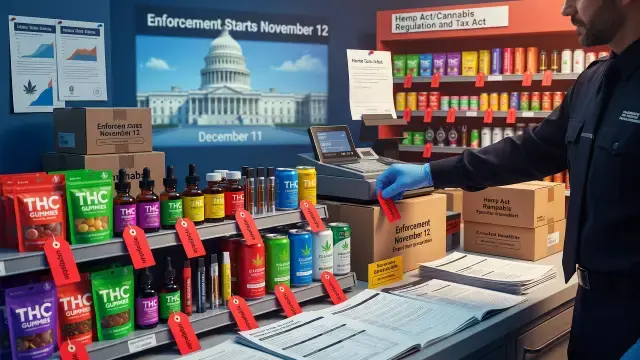
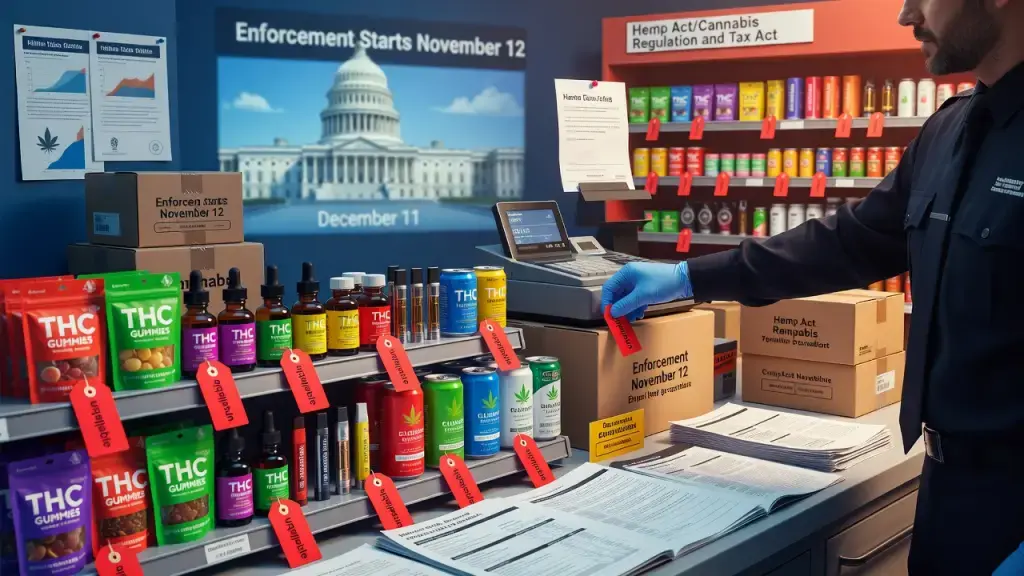
Illinois retailers selling hemp-derived THC products have less runway than they thought. A bulletin issued October 14 by the Illinois Department of Revenue confirms the state will enforce its new Hemp Act restrictions starting November 12 - nearly a month before the federal government's revised December 11 deadline kicks in for comparable products. For convenience stores, smoke shops, and other non-dispensary retailers carrying intoxicating hemp items, that gap matters a great deal.
Why the Federal Delay Doesn't Help Illinois Sellers
Congress pushed back most new federal hemp restrictions by 29 days in September, giving retailers nationally a bit more breathing room before stricter THC definitions take hold. Illinois isn't adopting that cushion. The Department of Revenue's bulletin is explicit on this point: state enforcement proceeds November 12 regardless of what happens at the federal level. The distinction is simple but consequential - federal law sets a floor, not a ceiling, and states remain free to move faster. Illinois is doing exactly that, building its own regulatory structure under the Cannabis Regulation and Tax Act rather than waiting on Washington's schedule.
The 0.4 Milligram Line That Changes Everything
Under the Hemp Act, any product containing more than 0.4 milligrams of total THC per container crosses into marijuana territory under state law. That's a low bar, and it reclassifies a wide swath of currently available hemp products - gummies, beverages, tinctures - as items only licensed marijuana dispensaries may sell. Businesses outside that regulated market lose the ability to sell or even possess these products with intent to distribute. In practice, though, this means a lot of inventory sitting on convenience store shelves right now becomes unsellable contraband in a matter of weeks.
Operators carrying high-THC hemp products essentially have three options, as outlined in the bulletin: stop ordering, return existing stock to distributors, or ship inventory to states where it remains legal until the later federal deadline. None of these are free. Returns strain distributor relationships and wholesale terms; interstate transfers add logistics costs and compliance headaches most small retailers aren't equipped to absorb on short notice.
What Still Qualifies as Hemp - and What Doesn't
Products at or below the 0.4 milligram threshold can continue selling outside dispensaries, provided they meet the Hemp Act's other requirements. Those aren't minor:
- Laboratory testing through facilities approved by the Illinois Department of Agriculture, using existing marijuana testing standards until hemp-specific protocols exist
- Restrictions on synthetic cannabinoids
- Child-resistant packaging
- Labels disclosing cannabinoid content, ingredients, serving size, expiration date, and access to a certificate of analysis
Smoking and vaping products don't qualify under the state's definition of an allowable final consumer hemp cannabinoid product, full stop - no exceptions carved out for low-THC formulations in that category.
Enforcement Risk and the Compliance Math
Retailers that keep selling newly reclassified products without a marijuana license face civil or criminal violations, seizure of inventory, and additional taxes, penalties, and interest. That last part deserves attention from anyone doing the math on margins: this isn't just a stop-sale order, it's a potential tax liability stacked on top of lost product value.
The broader signal here is that Illinois regulators are treating hemp-derived THC the same way they treat marijuana when potency crosses a defined line - same licensing requirements, same testing infrastructure, same enforcement posture. For multi-state operators and wholesalers tracking divergent state timelines, Illinois is a reminder that federal hemp policy sets expectations, not guarantees. State agencies can and will move on their own clock, and retailers need compliance systems built to track jurisdiction-specific deadlines rather than assuming uniformity across state lines.