
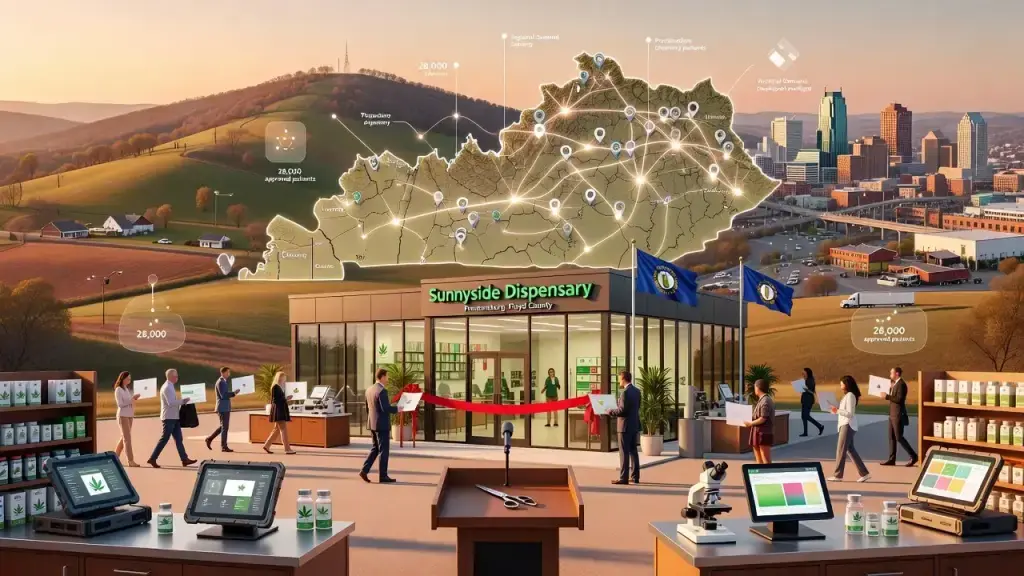
Kentucky's medical cannabis program has reached a milestone operators have been watching for months: every one of the state's 11 dispensary licensing regions now has an operating storefront. Governor Andy Beshear made the announcement following the opening of Sunnyside Dispensary in Prestonsburg, Floyd County, bringing the statewide total to 26 active dispensary locations. That geographic completion matters less as a symbolic marker and more as a signal that the program's distribution infrastructure has finally caught up to its patient registry.
Why Regional Coverage Is a Real Operational Milestone
Standing up a dispensary in every licensing region is not simply a matter of flipping a sign on. Each location has had to clear facility inspections, security requirements, local zoning approval, and seed-to-sale tracking integration before a single product batch could move across a counter. In practice, though, rural regions tend to lag urban ones - fewer qualified operators bid for those licenses, commercial real estate options are thinner, and build-out financing is harder to secure when a dispensary can't easily access traditional banking. Floyd County's opening suggests Kentucky's Office of Medical Cannabis managed to close that gap faster than many state-launched programs typically do.
For multi-state operators and in-state licensees alike, full regional coverage changes the wholesale math. With 46 medical cannabis businesses now running statewide, cultivators and processors finally have a distribution footprint wide enough to plan production volume against actual regional demand rather than guesswork. That's not a small thing for inventory planning, wholesale menu pricing, or deciding where to locate the next processing facility.
Qualifying Conditions Just Got Broader - And That's a Compliance Signal
Beshear's June 2026 executive order directed the Office of Medical Cannabis to issue an emergency regulation clarifying qualifying conditions, adding 15 recognized conditions including sickle cell anemia, ALS, Crohn's disease, Parkinson's and terminal illness. For dispensary operators, this is not a marketing opportunity - it's a compliance and patient-intake issue. Front-of-house staff and registered practitioners need updated protocols to verify qualifying diagnoses correctly, and point-of-sale systems tied to the state's patient registry have to reflect the expanded condition list without creating gaps in recordkeeping.
With more than 500 registered medical cannabis practitioners and over 28,000 approved patients statewide, the expanded eligibility list will likely push both numbers higher. That's good news for operators sitting on underused capacity, but it also raises the bar on compliance logs, physician registration verification, and age and identity checks at the point of sale. Kentucky's program, like most state medical markets, treats patient verification as a non-negotiable layer of consumer protection - not a formality.
What This Means for Operators and Investors Watching Kentucky
Full regional saturation tends to shift a market's center of gravity from licensing competition to operational execution. The land grab phase is effectively over in Kentucky; what comes next is about margin discipline, lab testing consistency, and whether 26 dispensaries can actually serve patient demand across a state with significant rural stretches.
- Wholesale suppliers should expect sharper regional demand signals now that every licensing region has retail access.
- Compliance teams need to update patient-eligibility screening to reflect the 15 newly recognized conditions.
- Dispensary staffing and inventory planning in rural regions will face different pressures than urban counterparts, given thinner practitioner density.
- Investors evaluating Kentucky operators should weigh regional saturation against per-store patient volume, not just license count.
To put it plainly: Kentucky now has the geographic skeleton of a functioning medical cannabis market. Whether it becomes a well-run one depends on what the Office of Medical Cannabis does with enforcement, testing oversight, and patient access in the months ahead - not on today's announcement alone.