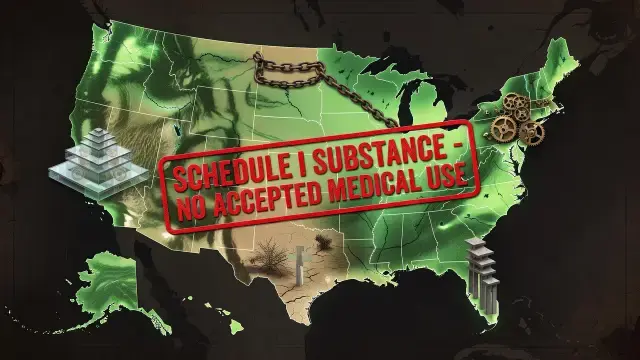
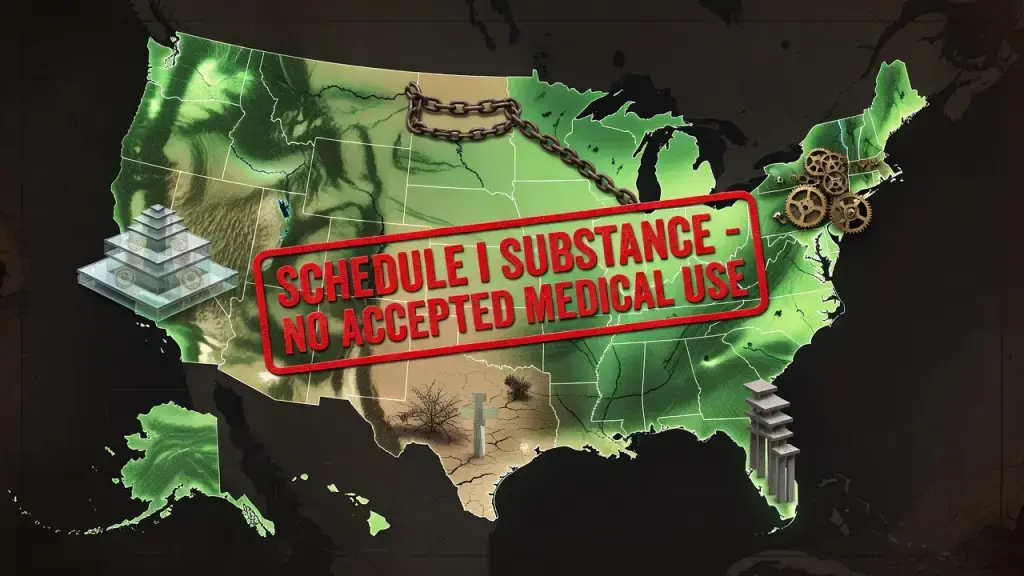
The U.S. medical cannabis industry runs on a legal fault line that never quite closes. Thirty-eight states plus Washington D.C. recognize medical cannabis under state law, while the federal government still classifies it as a Schedule I substance with no accepted medical use. That contradiction isn't a footnote - it's the operational spine of the entire business, dictating everything from how dispensaries bank their cash to how multistate operators structure their balance sheets.
A State-by-State Business Model, By Necessity
Because interstate commerce in cannabis is federally prohibited, operators can't build the kind of integrated supply chain that any ordinary consumer goods company would take for granted. No shipping product from a Colorado cultivation facility to a New Jersey dispensary. Instead, every multistate operator has to stand up redundant infrastructure - cultivation, processing, packaging, distribution - inside each state where it holds a license. That duplication is expensive, and it's one reason per-license valuations in competitive states run so high. Pennsylvania and New York both cap dispensary permits, which creates scarcity, which in turn rewards whoever got licensed first. Early movers end up with a structural moat that newer applicants simply can't buy their way into.
The Physician Gate and the 280E Problem
Medical cannabis also differs from adult-use retail in a basic way: patients need a certifying physician before they ever reach the register. That two-sided demand structure means patient volume tracks physician comfort levels, not just retail marketing or product selection. States that expand qualifying conditions - PTSD, chronic pain, and others relevant to veteran populations - effectively widen the top of the funnel for the entire medical channel.
Then there's the tax question, which is less a wrinkle than a wall. Section 280E of the Internal Revenue Code bars businesses trafficking in Schedule I or II substances from deducting ordinary business expenses. For a cannabis retailer, that routinely pushes effective federal tax rates toward 70% of gross profit - compare that to the standard 21% corporate rate available to literally every other industry selling a legal product. Smaller operators feel this hardest. They don't have the volume to absorb the drag the way a large multistate operator can, and it chokes off the capital they'd otherwise reinvest in compliance systems, lab testing partnerships, or store buildout.
Banking, Compliance Logs, and the Cost of Staying Legal
Banking access remains thin. Most federally chartered institutions still avoid cannabis accounts outright, pushing operators toward cash-heavy operations, private lenders, or costly workaround arrangements - all of which eat into margins that are already compressed by 280E. Add to that the seed-to-sale tracking requirements running through systems like Metrc in a majority of medical states, plus state-specific rules on vertical integration, environmental review, and local jurisdiction sign-off, and the compliance overhead for a single-state license can rival what a national retailer would spend across a dozen markets. Pennsylvania's dispensary permit structure, Florida's vertical integration mandate, and California's multi-tier approval process each illustrate the same point from a different angle: there is no shortcut version of compliance in this industry.
What the DEA's Rescheduling Proposal Actually Changes
The DEA's 2024 proposal to move cannabis from Schedule I to Schedule III drew tens of thousands of public comments and has already shifted how institutional capital views the sector, even before any final rule takes effect. If finalized, Schedule III status would eliminate 280E exposure for licensed operators - a meaningful release of capital that's currently absorbed by excess tax burden rather than reinvested in product safety, lab testing infrastructure, or staff training. It would not, on its own, legalize cannabis federally or open interstate commerce; that remains a separate legislative question requiring congressional action. Operators and investors banking on rescheduling as a cure-all for the industry's structural costs are getting ahead of what the rule actually does.
Where the Real Near-Term Opportunity Sits
Restricted low-THC states - Texas among them - represent an underbuilt segment of the market. Narrow qualifying-condition lists currently limit patient registries well below what the population could support, and any legislative expansion would open one of the larger addressable patient pools in the country almost overnight. Separately, physician certification through telehealth, normalized during the pandemic, remains underdeveloped as a dedicated business line. A compliant, state-credentialed telehealth certification platform touches no plant material, carries no 280E exposure, and scales across medical states with comparatively modest regulatory lift - a structurally different risk profile than running a dispensary or cultivation facility.
None of this changes the baseline reality for patients or operators: cannabis products carry real variability in potency and formulation, lab testing and compliant packaging exist precisely because that variability needs managing, and medical access does not substitute for broader consumer protections around age verification, dosing transparency, and product labeling. The business opportunity and the safety obligation run on parallel tracks - operators who treat them as separate problems tend to be the ones regulators notice first.