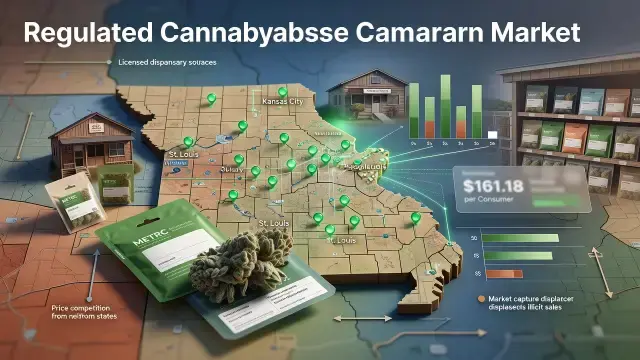
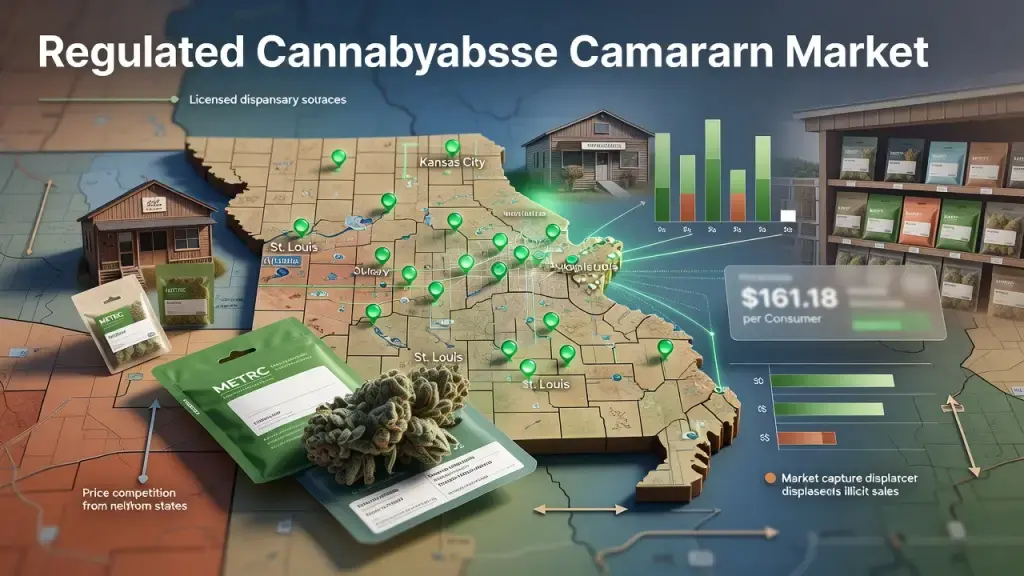
A new state-funded study has produced the first hard look at Missouri's cannabis economy since voters approved adult-use sales in November 2022, and the headline number is a strong one for regulators: licensed dispensaries now account for 93% of all marijuana transactions statewide. The remaining share presumably flows through unregulated channels - gifting arrangements, legacy dealers, out-of-state product moving across borders. For a market barely two years into adult-use retail, that capture rate is notable.
Why Market Capture Matters More Than Revenue Totals
Here's the thing about illicit-market displacement: it's the real test of whether a regulated cannabis program is working, not just tax collections or license counts. States that legalize adult-use sales but fail to pull consumers into the licensed system end up with the worst of both worlds - a compliance apparatus (seed-to-sale tracking, lab testing, COA requirements, compliant packaging) layered on top of a market that largely ignores it. A 93% capture rate suggests Missouri's licensing structure, pricing, and retail access points are functioning as intended. That's a meaningful data point for operators who've sunk capital into build-outs, METRC compliance systems, and point-of-sale infrastructure on the bet that the legal channel would actually win consumer behavior.
In practice, though, capture rate isn't static. It moves with price competition from neighboring states, enforcement posture against unlicensed sellers, and how easy regulators make it for new dispensaries to open. Missouri will need repeat studies to know whether 93% holds, climbs, or slips as the market matures.
Even Geographic Distribution Signals a Maturing Retail Footprint
The study also found sales spread evenly across the state rather than clustering in Kansas City, St. Louis, and a handful of metro corridors. That's worth sitting with. Even distribution typically reflects a licensing framework that didn't overly concentrate retail permits in urban cores - a deliberate or at least favorable outcome for rural dispensary operators and for social equity license holders who may have opened stores outside the biggest metro markets. For landlords and site-selection teams, it's a signal that demand isn't purely a function of population density; local market conditions, drive-time access, and the absence of saturation in a given county can matter just as much.
Wholesalers and brands should read this as a distribution cue too. A market where sales aren't concentrated in two or three cities requires a different approach to delivery manifests, inventory allocation, and wholesale menu planning than a market where demand is lopsided.
Flower Still Leads, and Spending Patterns Tell Their Own Story
Consumers in Missouri are still buying flower over concentrates, edibles, vapes, or other product formats, according to the study - a pattern consistent with mature adult-use states where flower remains the anchor SKU even as product diversification expands. Average monthly spend per consumer came in at $161.18 across all product categories, a figure that gives operators a usable benchmark for basket-size expectations and loyalty-program design.
For dispensary operators, this matters operationally. Flower-heavy demand means budroom inventory management, batch tracking, and shelf-life monitoring carry more weight than they might in a market tilted toward shelf-stable edibles. It also has implications for 280E tax exposure, since flower margins and turnover rates differ from manufactured products, and for how stores manage SKU counts against limited retail floor space.
What Regulators and Operators Should Watch Next
- Whether the 93% capture rate holds as neighboring-state competition and price pressure evolve
- How evenly distributed sales affect future license allocation and zoning decisions
- Whether flower's dominant share shifts as consumer familiarity with other formats grows
- How spending averages inform tax revenue forecasting and compliance resourcing
None of this changes the baseline reality that cannabis remains a tightly regulated, age-restricted product category with real consumer-safety obligations attached - lab testing, potency labeling, and packaging rules exist precisely because the product carries risk and requires oversight, not because the market is risk-free. A 93% capture rate is a strong early signal for Missouri's program design. Whether it holds is a question for the next study, not this one.