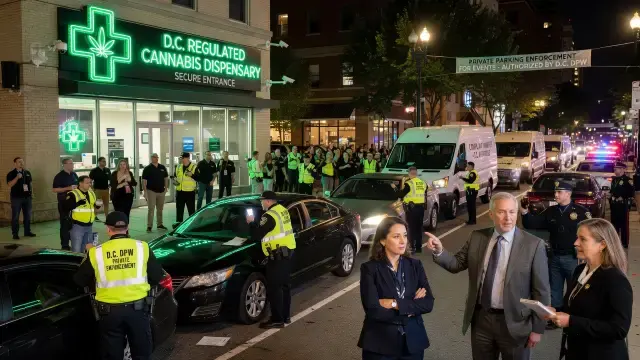
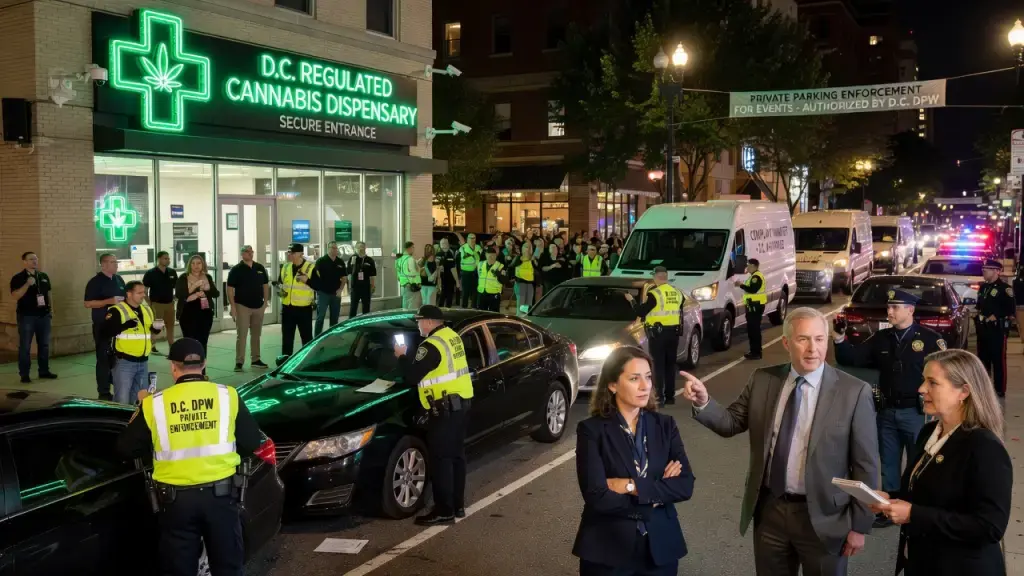
The D.C. Council passed a bill Tuesday letting private event organizers and businesses hire off-duty parking enforcement officers through the Department of Public Works to manage congestion around their own functions. The organizers, not the city, cover the overtime cost. For any business that depends on foot traffic, late-night crowds, or scheduled events - including dispensaries operating in the District's regulated adult-use and medical markets - the bill touches a problem that rarely gets discussed in licensing conversations: what happens on the curb outside the storefront.
Why Curbside Chaos Is a Retail Problem, Not Just a Traffic One
Illegal parking around peak hours isn't just an inconvenience. It's a liability and access issue. Dispensaries in D.C. already operate under tight security and access-control requirements - ID checks at the door, surveillance obligations, restrictions on loitering - and a block clogged with double-parked cars complicates all of it. Delivery manifests get delayed. Customers circling for a spot linger near entrances longer than compliance officers would like. And for operators near bars, restaurants, or event venues, the externalities Council member Brianne Nadeau described - congestion created by businesses that profit from drawing large crowds - can spill directly onto a dispensary's block even when the dispensary itself didn't cause it.
The bill's logic is straightforward: businesses that generate the traffic should bear the cost of managing it, rather than pushing enforcement expense onto the city's general parking budget. That's a reasonable principle on paper. In practice, though, it raises a question every cannabis retailer should be asking now - who decides when a dispensary counts as the kind of "private party" generating enough externality to justify hiring enforcement, and who pays when a neighboring venue's crowd parks illegally in front of a licensed cannabis storefront instead of their own?
Revenue, Enforcement, and the Optics Problem
Council member Robert White's objection - that the city already pulled in significant revenue from parking enforcement last year and shouldn't lean on tickets as a funding mechanism - is worth sitting with. Cannabis operators know this tension well. Excise tax, licensing fees, and compliance costs already stack up fast in a market where 280E limits standard business deductions at the federal level. Any new fee structure, even one framed as privately funded, tends to get scrutinized by operators who are already managing thin margins. If enforcement near commercial corridors becomes heavier or more targeted, dispensary owners should factor that into site selection, delivery scheduling, and customer communication, particularly for storefronts near nightlife districts or event venues where curbside pressure is highest.
What Operators Should Watch Next
The bill also expands ticketing authority to campus police and special police officers, broadening who can issue citations across the District. That's a meaningful shift in enforcement capacity, not just a parking footnote.
- Dispensaries near universities, event spaces, or mixed-use corridors may see more frequent and varied enforcement presence.
- Delivery drivers carrying manifests and compliant packaging should anticipate stricter loading-zone enforcement near busy retail blocks.
- Operators sharing a commercial strip with bars, clubs, or event venues should track whether neighboring businesses opt into private enforcement, since spillover parking pressure could shift onto adjacent storefronts.
None of this changes product compliance, lab testing, or point-of-sale requirements. But it's a reminder that a dispensary's regulatory footprint doesn't end at the door. The curb matters too - and in a city tightening its grip on both revenue and public order, it's a line item worth watching.