Cash, not revenue, has become the dividing line between cannabis operators that survive and ones that quietly fall apart. Over the past five years, dozens of multi-state operators chased top-line growth through debt-fueled acquisitions and repeated equity raises, only to find that a growing sales figure means little when operating cash flow stays negative and the balance sheet buckles under interest payments. Green Thumb Industries (OTC: GTBIF) has avoided that trap, and its first-quarter results are a useful case study in what disciplined cannabis retail actually looks like on paper.
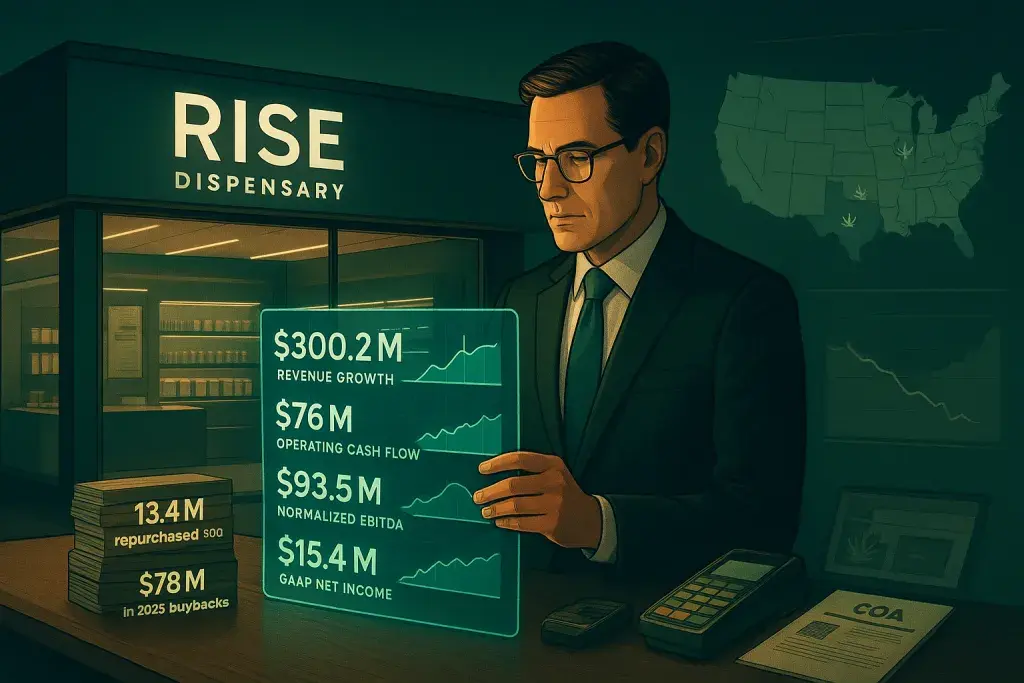
Revenue rose 7.4% year over year to $300.2 million, a modest but steady gain in a sector where flat or declining same-store sales are common in mature markets. What stands out more is the cash generation underneath that number: $76 million in operating cash flow, $93.5 million in normalized EBITDA, and GAAP net income of $15.4 million. That last figure matters because 280E, the federal tax code section that bars cannabis companies from deducting standard business expenses, continues to inflate effective tax rates across the industry regardless of state legality. Posting GAAP profitability under that burden is not trivial. Part of that operational consistency comes down to infrastructure choices that rarely make headlines - reliable seed-to-sale tracking, tight SKU management, and dependable point-of-sale for Minnesota dispensaries and other newly entered markets, all of which reduce shrinkage and keep compliance logs clean as the footprint expands. point-of-sale for Minnesota dispensaries
Green Thumb ended the quarter with roughly $344.5 million in cash and equivalents against $289.9 million in total debt - a balance sheet posture that gives management options most peers don't have. Rather than issuing new shares to fund growth, a move that dilutes existing holders and has burned investors across the sector repeatedly, the company repurchased about 6 million shares for $33.3 million during the quarter and another 7.4 million shares after quarter-end, pushing 2025 buybacks toward $78 million. Buybacks of that size signal something specific: management believes the stock trades below intrinsic value and that the underlying business throws off enough free cash to reward shareholders without starving future expansion.
Selective Expansion Over Growth at Any Cost
Green Thumb now runs more than 110 Rise dispensaries nationally, with exposure spread across both medical and adult-use markets rather than concentrated in a single regulatory category. That diversification matters because state-level cannabis policy remains inconsistent - a market can shift from medical-only to adult-use, or face new license caps and social equity requirements, with little federal harmonization to soften the transition. The company's moves into Minnesota and Texas reflect a pattern of entering markets deliberately rather than racing competitors into every newly legalized state. That restraint, unglamorous as it sounds, is precisely what separated survivors from the operators now trading as penny stocks or delisted entirely.
What the Broader Market Still Faces
None of this erases the structural headwinds facing cannabis retail. Federal legalization remains stalled, 280E still distorts profitability calculations across the industry, and wholesale pricing pressure persists in oversaturated state markets where new licenses keep entering supply faster than demand grows. Lab testing requirements, compliant packaging standards, and COA documentation add real operating costs that vary by state and show no sign of harmonizing soon. Cashless payment limitations, tied to cannabis's federal status, continue to complicate point-of-sale operations and push many dispensaries toward cash-heavy models that carry their own security and accounting burdens.
Smaller operators may still deliver sharper upside if federal reform accelerates, simply because they carry more risk and more room to re-rate. Green Thumb isn't positioned as that kind of bet. Its case rests on something more basic: proof that a cannabis company can generate real cash under today's rules, not a hypothetical set written for tomorrow. In a sector where investors have spent years waiting for fundamentals to catch up with expectations, that track record carries its own kind of weight.