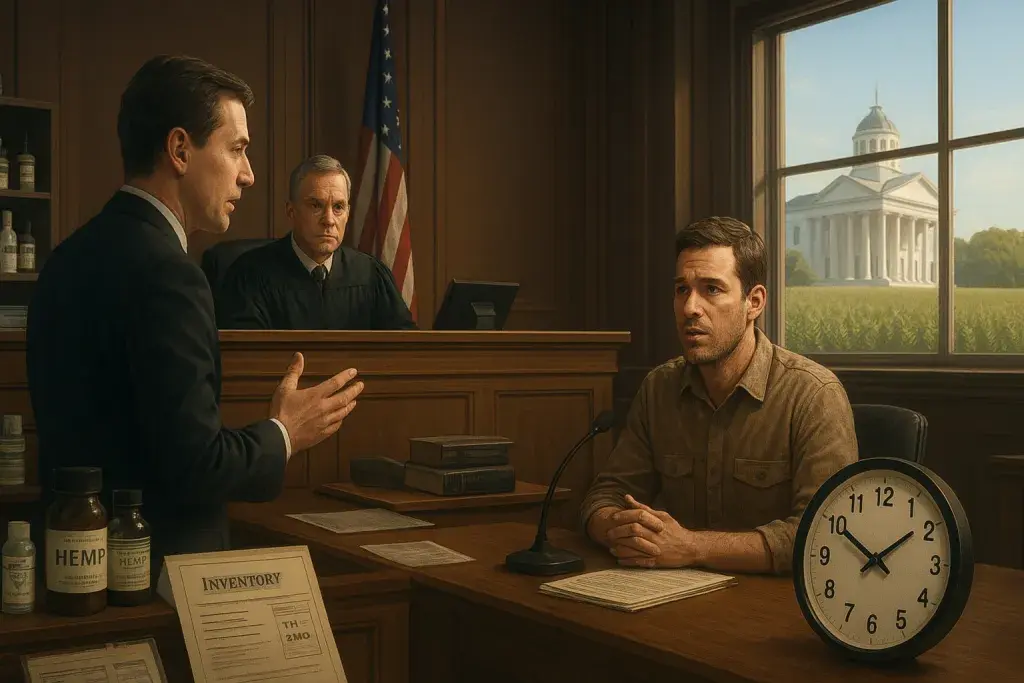
A federal judge spent nearly five hours Wednesday weighing whether to pause Virginia's new hemp restrictions before they take effect Saturday, as store owners testified the rules could force them out of business almost overnight. U.S. District Judge Robert S. Ballou heard from seven hemp businesses seeking a temporary injunction against House Bill 30, the budget measure that eliminates the state's 25-to-1 CBD-to-THC exception and caps most hemp products at two milligrams of total THC per package. No ruling came Wednesday, but attorney Chap Petersen, who represents the plaintiffs, said he expects a decision by Friday - just ahead of the Aug. 15 deadline.
The case lands at a moment when hemp retailers nationwide are already adjusting to tighter state-level THC thresholds, inconsistent testing standards, and shifting definitions of what counts as legal hemp versus regulated cannabis. Virginia's shift is part of a broader pattern: states preparing adult-use marijuana markets are moving to close what regulators call the hemp loophole, tightening potency limits and packaging rules that once let intoxicating hemp-derived products circulate with minimal oversight. For operators trying to stay compliant through that transition, back-office infrastructure matters as much as the legal fight - inventory tracking, COA management, and point-of-sale systems built for regulated cannabis retail, the kind of tools already standard in mature markets that rely on platforms like cannabis pos systems vermont retailers use to manage compliant SKUs, are becoming relevant to hemp shops that never expected to operate under cannabis-style rules.
What the Lawsuit Actually Asks For
Petersen was careful to frame the request narrowly. The businesses are not asking the court to strike down HB 30 outright - at least not yet. They want a temporary injunction blocking enforcement while a separate constitutional challenge plays out, potentially in a trial early next year. "If we could get an injunction, then my clients would have the ability to sell their inventory, stay in business," Petersen said. That distinction matters procedurally: a preliminary injunction requires showing irreparable harm and a likelihood of success on the merits, a lower bar than winning the underlying case outright, but still no guarantee.
Central to the plaintiffs' argument is timing. Gov. Glenn Youngkin didn't sign the budget language until June 29, leaving businesses roughly 45 days to unwind product lines built around the old 25-to-1 ratio. For an agricultural commodity, that's an unusually tight runway. Hemp crops planted in April, with harvest expected around October, can't simply be redirected to another state's market the way a piece of equipment might. Once a batch is harvested and processed into a finished product, it either meets the new state definition of legal hemp or it doesn't - and if it doesn't, it becomes an unsellable liability sitting on a shelf.
The Compliance Cliff Facing Retailers
What's striking about this dispute is the binary nature of the deadline. Products legal at 11:59 p.m. Aug. 14 could fall outside the legal definition of hemp one minute later, exposing retailers to felony liability for inventory they lawfully stocked the day before. That's not a gradual compliance ramp-up; it's a cliff. Store owners like Cody Moorefield of Simply Hemp described the resulting uncertainty bluntly - no clear guidance from the state's new cannabis regulatory agency on what to do with existing stock, no town halls, no published transition policy. For an industry accustomed to seed-to-sale tracking and lab-verified COAs, the absence of regulatory communication is its own kind of risk.
Broader Stakes for the Hemp Market
Beyond the individual businesses named in the suit, the case touches the wholesale relationships that keep small hemp retailers stocked. Moorefield noted that many products on his shelves come from Virginia-based manufacturers who built compliant formulations under the previous framework - investments that could be rendered worthless if the two-milligram cap holds. The Cannabis Small Business Association, which backs the litigation, has pointed to prior economic survey data suggesting hemp-derived cannabinoid sales in Virginia reached well into the hundreds of millions of dollars annually, underscoring how much retail and manufacturing activity sits downstream of this single regulatory change. Whether Judge Ballou grants breathing room or lets the Aug. 15 deadline stand, the ruling will shape how quickly - and how carefully - other states move against similar hemp loopholes.