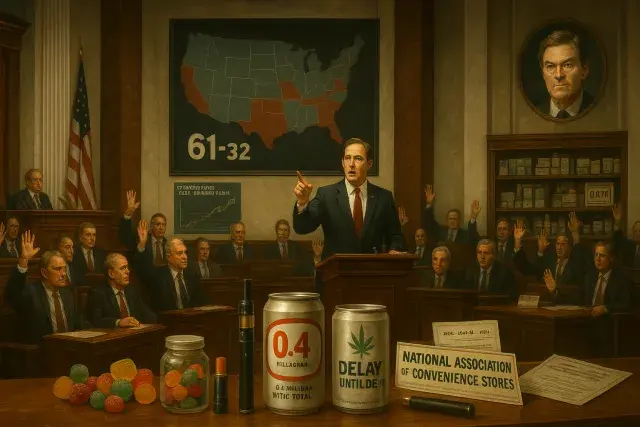
A one-month reprieve for the intoxicating hemp industry will stand, after the Senate voted 61-32 on Aug. 8 to table an amendment from Sen. Ted Budd, R-NC, that would have kept the federal hemp crackdown on its original Nov. 12 start date. Budd's amendment, S.Amdt. 6747, sought to strip Section 2019 from the continuing resolution - the provision that pushes the effective date of last year's hemp restrictions to Dec. 11 instead. The vote crossed party lines, with 21 Republicans joining 11 Democrats against tabling, a split that says as much about regional hemp economies as it does about ideology.
For operators outside the hemp-derived intoxicant space - licensed cannabis retailers in states with regulated adult-use or medical programs - this fight matters less for its outcome than for what it reveals about the regulatory patchwork retailers are now expected to navigate. States like Texas, where hemp-derived products with intoxicating potential have circulated largely outside the state's tightly licensed medical cannabis framework, illustrate the compliance gap Congress is trying to close. Retailers operating under actual state licensure, tracking inventory through seed-to-sale systems and running compliant point-of-sale platforms, have watched the unregulated hemp market undercut their pricing and their credibility with regulators alike. That divide is part of why tools built for licensed operators - including POS software for Texas cannabis retailers - have become more than a convenience; they're a compliance necessity as states and the federal government sort out where the lines fall. POS software for Texas cannabis retailers
What the Federal Change Actually Does
The underlying law, passed in November 2025, redefines hemp based on total THC content rather than delta-9 THC alone, and it caps finished hemp-derived cannabinoid products at 0.4 milligrams of combined total THC and similar cannabinoids per container. That's a dramatically tighter threshold than the 0.3% delta-9 standard that has governed hemp since the 2018 Farm Bill - a gap that convenience stores, gas stations, and grocery chains have exploited to sell intoxicating gummies, beverages, and vape products with minimal oversight. Budd argued that gap amounts to a public-health failure, citing North Carolina emergency department data showing cannabis-related visits among minors rose sharply between 2017 and 2025. Whether Congress ultimately enforces the 0.4-milligram cap on schedule or revisits it again before Dec. 11 remains genuinely unsettled.
A Fractured Coalition, Not a Clean Partisan Fight
What's striking here is how little this divided along conventional lines. The White House, through CMS Administrator Dr. Mehmet Oz, opposed Budd's amendment on the grounds that abrupt implementation could disrupt CBD access for seniors and people with disabilities under recent Medicare and Medicaid initiatives. Meanwhile, 105 organizations - including the US Hemp Roundtable, the National Association of Convenience Stores, and several North Carolina hemp trade groups - lobbied to preserve the delay, framing it as breathing room for Congress to legislate testing standards, packaging requirements, and import controls on synthetic cannabinoids rather than simply banning broad categories of product. Budd, Sen. Pete Ricketts, and Sen. Tom Cotton pushed back hard in a closed-door lunch, arguing the delay simply protects an industry that should have been reined in already. Both sides agree the current retail environment is unsustainable; they disagree sharply on the mechanism.
North Carolina's Parallel Standoff
The state-level fight in Raleigh mirrors the federal one almost exactly. House Bill 328 would import the same 0.4-milligram total THC threshold into North Carolina law, effectively banning most THC beverages, delta-8 products, vapes, and THCA flower from store shelves, while setting a 21-and-older purchase age. The Senate passed the conference report 37-6 in July, but House leadership has repeatedly declined to bring it to a floor vote, leaving it parked in the Rules Committee. Speaker Destin Hall has acknowledged the unregulated market can't continue as-is but wants a smaller working group to refine the approach before year's end. That's a familiar pattern for cannabis-adjacent regulation: broad agreement that the status quo is untenable, paired with real disagreement over whether prohibition or a licensing-and-testing framework is the better fix. For operators building compliance infrastructure, the lesson is the same at both the state and federal level - the rules are moving, and the businesses that survive the transition will be the ones already running clean inventory logs, verified lab testing, and age-gated sales before the deadlines arrive, not after.