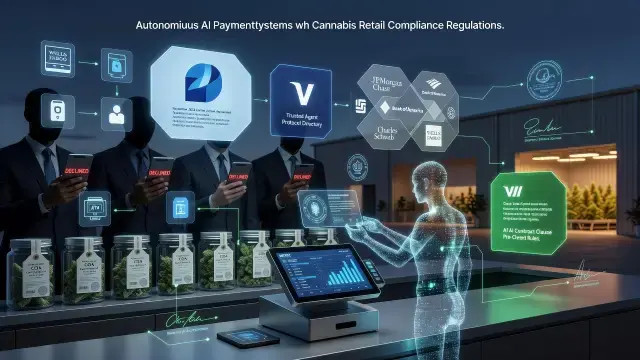
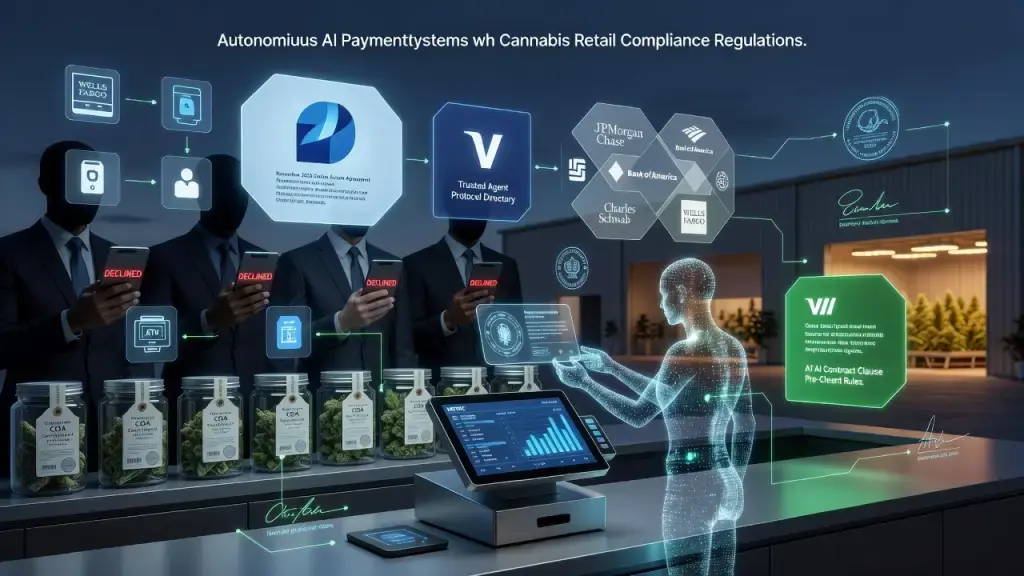
Three banks picked up the phone this fall and said no to autonomous payment agents. One bank said yes in advance, buried in a contract clause. A payments consortium said the buyer already said yes, somewhere upstream, before the agent even showed up. None of this happened in cannabis retail. All of it will land there anyway.
Dispensary operators have spent years building compliance stacks around a simple assumption: a human approves the transaction at the point of sale. METRC tracks the product. A POS terminal captures age verification. A budtender or manager signs off on the batch, the price, the tender type. That chain of custody for decision-making is the whole point of seed-to-sale accountability. Agentic commerce breaks that chain by moving the approval decision somewhere else entirely - into a bank's terms of service, a payment network's directory, or a token minted weeks before anyone walks up to a counter.
Why This Matters for a Cash-Starved Industry
Cannabis retail already runs on a patchwork of workarounds because federal banking restrictions keep plenty of institutions away from the plant altogether. Cashless ATM transactions, closed-loop payment apps, and state-chartered credit unions have filled gaps that mainstream processors won't touch. Now layer in a separate fight happening in mainstream finance over who gets to authorize an AI agent to move money, and the stakes for dispensary operators get more complicated, not less.
Here's the catch: if JPMorgan, Bank of America, Schwab and Wells Fargo are fighting over liability for agent-initiated transfers in ordinary retail and brokerage accounts, the cannabis-adjacent financial institutions that already tolerate more risk than their peers will be even more cautious about agentic payment rails touching plant-touching businesses. A bank that blocks agents for a conventional retailer isn't going to extend goodwill to a dispensary chain asking for the same access. Compliance teams at multi-state operators should expect agentic payment tools, if they arrive in this sector at all, to come with tighter gates and slower rollouts than in unregulated retail.
The Authorization Artifact Problem, Applied to Dispensaries
The real shift described in the banking fights isn't about agents behaving badly. It's about where the "yes" lives. Wells Fargo's November 2026 Online Access Agreement update treats any transaction an agent initiates as if the accountholder did it personally - authorization baked into the contract, not into the moment of the transfer. Visa's Trusted Agent Protocol takes a different approach: the buyer approves in advance, and a registered agent executes against that pre-cleared scope using tokenized credentials pulled from a directory.
Translate that into cannabis retail terms. Picture a wholesale buyer for a dispensary chain using an agent to reorder flower from a cultivator once inventory on a given SKU drops below a threshold. Who authorized that purchase - the buyer who set the rule weeks earlier, the software vendor who built the agent, or the payment processor who approved the token? If a reorder triggers at the wrong price, pulls from a mislabeled batch, or ignores a hold placed because a COA hasn't cleared lab testing, the liability question won't be hypothetical. It will look exactly like the dispute playing out in banking right now, just with a regulated product and a state tracking system watching every unit.
What Operators and Compliance Teams Should Watch
None of this is live in cannabis commerce yet, and operators shouldn't treat agentic purchasing as an imminent operational reality. But the architecture being built elsewhere will eventually reach wholesale ordering, vendor payments, and possibly consumer-facing checkout if state rules ever permit it. A few things worth tracking now:
- Whether payment processors serving cannabis businesses adopt directory-based agent registration similar to Visa's model, or lean toward blanket contractual authorization like Wells Fargo's.
- How liability for a wrongly executed wholesale order - wrong price, wrong quantity, non-compliant batch - would be allocated among software vendor, processor, and buyer under existing merchant agreements.
- Whether state cannabis regulators, who already require detailed transaction logging under seed-to-sale systems, will demand that any automated purchasing decision be traceable to a specific human approval, not just a pre-set rule.
In practice, though, the sharper lesson for dispensary owners and compliance officers is less about agents specifically and more about the habit of checking where approval actually sits in any new payment or ordering tool. Vendors will market automation as convenience. The question that matters - for a federally illegal-adjacent industry that lives and dies by audit trails - is who holds the authorization artifact, and whether a regulator or auditor can see it as clearly as they can see a METRC manifest.