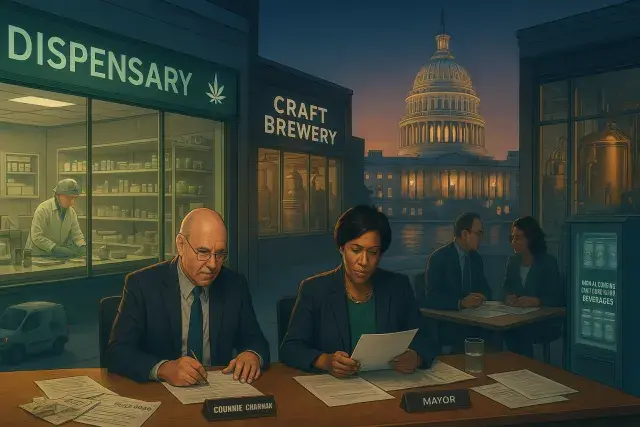
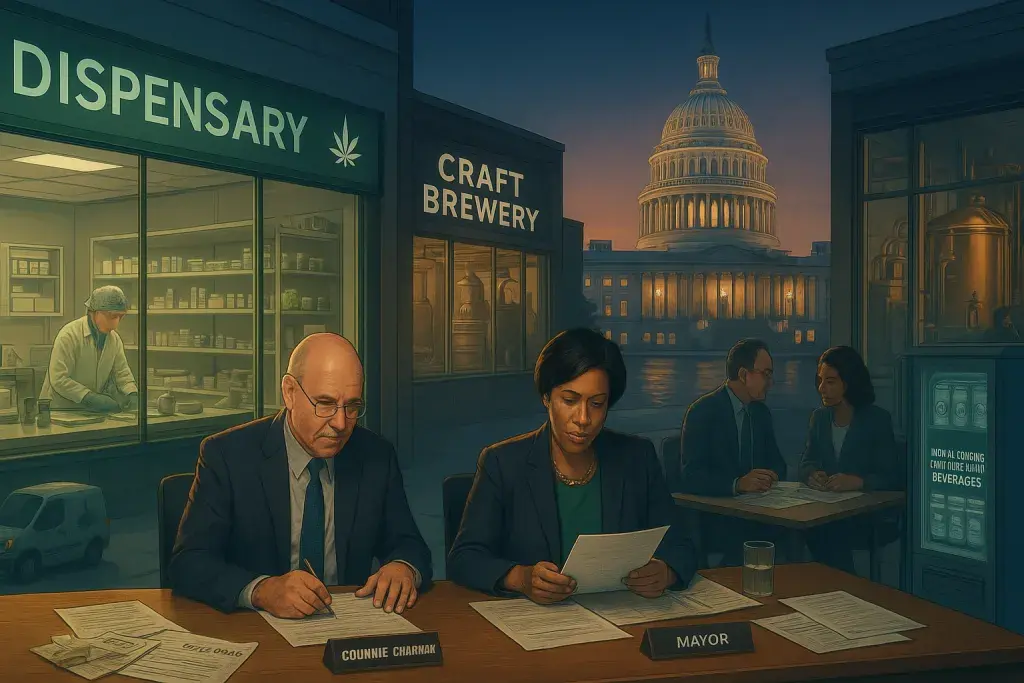
Washington, DC's medical cannabis program is up for a significant legislative expansion. The DC Council's Committee of the Whole has scheduled a public hearing for July 2 on three medical cannabis bills, all introduced at Mayor Muriel Bowser's request and sponsored by Council Chairman Phil Mendelson. Taken together, the package would extend licensing timelines for conditional licensees, allow dispensaries to manufacture certain products in-house, and open a new production pathway for local breweries and distilleries to enter the cannabis beverage market.
For operators tracking regulatory movement across the country - from mature markets with established pos cannabis nevada infrastructure to emerging markets still shaping their rules - DC's approach is worth watching. On-site preparation authority and cross-industry licensing partnerships are not uniquely DC ideas, but the city's specific mechanism for getting there has some genuine wrinkles that operators and compliance teams will want to understand before July 2 comes and goes.
What the Three Bills Actually Do
The most straightforward of the three is B26-0346, the Medical Cannabis Conditional Licensure Extension Amendment Act. What it does, in plain terms, is codify an extension that conditional license holders have already been operating under. In practice, that means making permanent - or at least stable - a timeline accommodation that was previously informal. For any licensee who built out operations, signed a lease, or hired staff on the assumption that the extension would hold, this bill converts that assumption into enforceable statute. That's not a small thing. License timeline uncertainty has derailed dispensary buildouts in more than a few regulated markets, and cementing an extension removes one layer of operational risk for affected operators.
B26-0259, the Medical Cannabis Retailer Craft Preparation Endorsement Act, opens more commercially interesting territory. Licensed dispensaries that obtain the endorsement would be permitted to prepare certain cannabis products on-site - specifically edibles, topicals, and prerolls. Here's the catch: the bill explicitly prohibits cannabinoid extraction and bars the use of butane or explosive gas in any preparation process. That's a meaningful constraint. It draws a hard line between light, retail-level preparation - think hand-rolling prerolls, mixing topical formulations, assembling edibles from compliant inputs - and full-scale manufacturing. Operators who want to add a production component to their retail footprint without building out or partnering with a separate licensed manufacturer would gain flexibility here, but they'll need to build compliance logs, staff protocols, and product batch documentation that reflect the new endorsement's specific scope. Any edible or topical moving through point-of-sale will carry its own labeling and testing obligations under existing DC medical cannabis rules.
The Beverage Bill Is the One to Watch
B26-0654, the Medical Cannabis Beverage Product Amendment Act, is the most structurally novel of the three. The bill would create a new production endorsement that allows licensed local breweries and distilleries to partner with licensed cannabis manufacturers to produce nonalcoholic, cannabis-infused beverages. Mayor Bowser, when announcing the legislation in April, framed it directly: "This is an opportunity to support two local industries. We have fantastic local brewers and distillers in our city, we have a robust medical cannabis market, and this is a new opportunity for those two markets to collaborate and create a safe and smoke-free alternative for patients in DC."
That framing matters for how the bill will likely be debated. Alcohol-adjacent licensing has historically drawn close scrutiny in cannabis regulation - federal law still prohibits the co-mingling of alcohol and cannabis licenses in most states, and regulators tend to apply extra layers of oversight to any arrangement that touches both industries. What's striking here is that the DC bill explicitly requires the final product to be nonalcoholic. The brewery or distillery contributes its production infrastructure and expertise; the cannabis manufacturer holds the cannabis-side license and the compliance chain. It's a bifurcated model, and whether the operational reality of joint production can stay clean inside that structure will depend heavily on how DC regulators write the endorsement rules. The bill also includes a medical cannabinoids import endorsement, expanded courier authority, and tax clarification provisions - which suggests the drafters anticipated some of the downstream compliance friction this kind of cross-industry arrangement creates.
Compliance and Operational Implications for DC Operators
For dispensary operators and cannabis manufacturers already licensed in DC, each of these bills represents a potential new revenue stream - and a new compliance obligation. On-site preparation endorsements typically require physical space separation, dedicated equipment, staff training documentation, and expanded record-keeping. That means operators who want to move quickly when and if B26-0259 passes will need to assess their current floor plan, their existing point-of-sale and inventory management systems, and whether their compliance infrastructure can handle dual-function operations - retail and light manufacturing - under one roof.
The beverage bill raises a different set of questions for cannabis manufacturers. A partnership with a brewery or distillery is a supply chain arrangement, not a simple wholesale transaction. It involves shared production schedules, co-developed formulations, and product batches that will carry COA requirements, compliant packaging mandates, and labeling obligations under DC's medical cannabis rules. Any cannabis manufacturer evaluating a potential partnership under this framework should be thinking now about contract structure, liability allocation, and how their seed-to-sale tracking system handles inputs that originate outside a licensed cannabis facility.
The July 2 public hearing is an open process. Residents and stakeholders can contact the Committee of the Whole for sign-up information. For operators, manufacturers, and industry professionals with a stake in how these rules are written, showing up - or submitting written testimony - is a direct input into the regulatory language that will govern how these endorsements actually work.