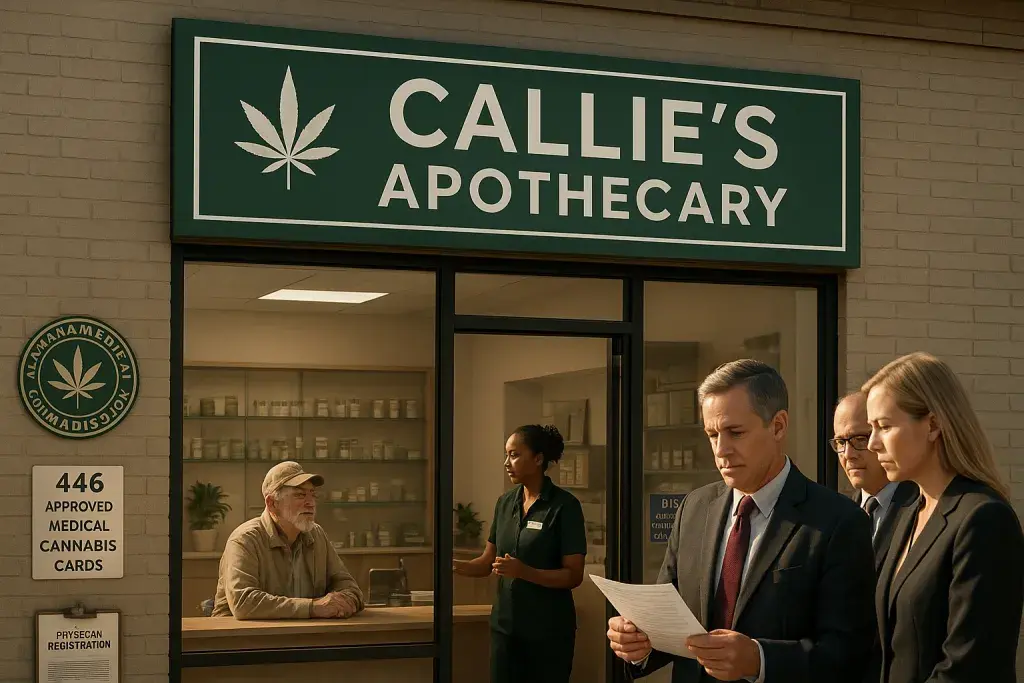
One week after Callie's Apothecary became Alabama's first licensed medical cannabis dispensary to open its doors - in Montgomery - the Alabama Medical Cannabis Commission convened Thursday to address two pressing gaps in the young program: a shortage of licensed testing laboratories and a signage rule that, practically speaking, makes dispensaries nearly invisible to patients who need them. The meeting offered a candid snapshot of where Alabama's medical cannabis program stands, what's working, and what still needs work.
The numbers are modest but meaningful for a program barely past its own starting line. As of Thursday, 52 physicians across the state had received approval from the Alabama Board of Medical Examiners to recommend medical cannabis treatment, with 39 completing the commission's registration requirements and three more pending. Just 446 Medical Cannabis Cards had been approved statewide, 21 licensed physicians had submitted cannabis requests for patients, and 102 patients had visited Callie's Apothecary since it opened, generating nearly $15,000 in sales. For context, early-stage medical markets in other states have followed similar trajectories - slow patient enrollment, physician hesitancy, and a tight initial SKU mix - before volume picks up as awareness builds. Operators in more mature markets who rely on purpose-built dispensary software nevada and similar platforms know that the first weeks of a new market are rarely representative of steady-state demand; the real operational pressure comes later, when patient volume scales faster than compliance infrastructure.
Commission Chair Sam Blakemore visited Callie's Apothecary on opening day and described what he found in operational terms worth noting: transparent pricing, patient education, efficient throughput - getting patients through the dispensary in 20 minutes or less - and what he characterized as excellent customer service. That kind of workflow discipline matters in a medical dispensary setting, where the patient population may include elderly, disabled, or first-time customers unfamiliar with the purchasing process. Blakemore also recounted a conversation with a departing patient, a retired military veteran who described two decades of struggling with PTSD-related sleep disruption and said he left with hope that medical cannabis could improve his quality of life. The commission chair shared the exchange without overstating it - and that restraint was appropriate. A regulated program's credibility depends on responsible messaging, not testimonials.
Testing Lab Shortage Prompts Commission to Reopen Applications
Here's the operational problem: Alabama currently has only one approved state testing laboratory for medical cannabis. The commission voted unanimously Thursday to reopen applications for additional lab licenses, with Blakemore citing the need to meet rules around retesting and challenged test results. That's not a procedural footnote - it's a compliance bottleneck. In any regulated cannabis market, testing labs are load-bearing infrastructure. Certificate of analysis requirements, mandatory potency and contaminant testing, and the ability to retest disputed batches are all standard features of a functioning seed-to-sale compliance system. With only one approved lab, turnaround times for test results could slow the entire supply chain, delay product releases to dispensaries, and create inventory gaps at retail. The prior application window, opened in February 2025, drew a single applicant - which the commission approved. Reopening the window now signals the commission recognizes that a one-lab market isn't sustainable, even at current patient volumes.
A 16-by-18-Inch Sign Is Not a Marketing Strategy
The commission also voted unanimously to grant Callie's Apothecary a permanent permit variance allowing it to install exterior signage larger than the current rule permits - a maximum of 16 inches by 18 inches. To put it plainly: that's not a sign. That's a plaque. Commissioner Eric Jensen said as much, noting that a sign that small "is not gonna be helpful," and called for the commission to revisit dispensary marketing requirements more broadly. Commission General Counsel Justin Aday confirmed that the approved sign doesn't depict the cannabis plant or mention the word cannabis - relevant because most state medical cannabis advertising rules restrict overt product references in exterior signage. The variance, Aday noted, gives the commission a documented basis to either revise the size limit or defer to local zoning restrictions, whichever is more restrictive in a given municipality.
This tension between state-level advertising rules and real-world retail visibility is familiar to operators in other medical markets. Dispensaries are licensed businesses operating in commercial corridors, and patients - particularly older or mobility-limited patients in a medical program - need to be able to find them. Overly restrictive signage rules, often borrowed from early-era cannabis regulations designed to minimize visibility, can work against patient access in a medical context. The commission's willingness to grant the variance and then use it as a policy lever to reconsider the rule itself is the right sequence. Whether broader rule changes follow is a question for future meetings.
What Alabama's Early Numbers Mean for the Program's Next Phase
Alabama's medical cannabis program is running, but it is running slowly - deliberately so, by the commission's design. The limited physician enrollment, modest card approvals, and single open dispensary reflect a cautious rollout rather than a failed one. The real stress test comes when additional dispensaries open, patient volume grows, and the compliance infrastructure - testing labs, inventory tracking, physician registration workflows - faces actual load. The commission's actions Thursday were largely preemptive: reopen lab applications before a bottleneck develops, fix the signage rule before other dispensaries open and face the same problem. That's sound regulatory practice. Whether Alabama's program scales smoothly will depend on how quickly those infrastructure gaps close.