
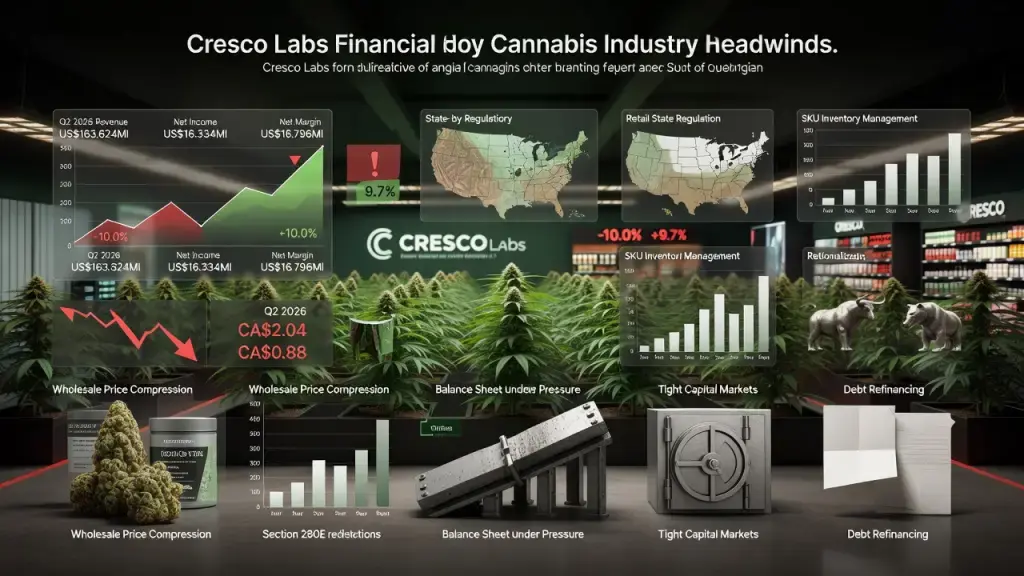
Cresco Labs shares fell 52.7% over the twelve months through October 2025, including dividends, even as the multi-state operator posted a swing from net loss to net profit in its most recent quarter. The disconnect between share price and operating results is the story here, and it says something broader about how investors are pricing risk in a cannabis sector still fighting wholesale price compression, tight capital markets, and uneven state-by-state regulation.
What the numbers actually show
Q2 2026 revenue came in at US$173.341 million, up from US$163.624 million a year earlier. More notably, net income flipped from a loss of US$16.334 million to a profit of US$16.796 million, pushing net margin from negative 10.0% to positive 9.7%. That's a real operating improvement, not a rounding error. But one profitable quarter doesn't settle the argument between the bulls, who point to new-market expansion and debt refinancing as durable tailwinds, and the skeptics, who see pricing pressure and regulatory friction as structural rather than temporary. The stock's move from CA$2.04 to CA$0.88 over the period suggests the market, so far, is siding with the skeptics regardless of the margin print.
Why wholesale pricing keeps eating margin
This is the part operators in mature adult-use states know too well. As license counts grow and cultivation capacity outpaces retail demand, wholesale flower and concentrate prices compress, squeezing margin even when top-line revenue holds up. Cresco Labs' bull case leans on roughly 51% adjusted gross margins and disciplined SG&A control as evidence the company can offset that compression through operational efficiency rather than relying on price appreciation across its footprint. That's a narrower, harder path than simply riding sector growth. It requires tight inventory management, SKU rationalization, and real pricing discipline at the wholesale menu level, not just cost-cutting at headquarters.
The 280E and capital-access backdrop
None of this happens in a vacuum. Federal tax code Section 280E still disallows standard business deductions for plant-touching cannabis companies, compressing after-tax cash flow even when operating margins look respectable on paper. Combine that with a lending environment that remains tight for multi-state operators - banks are still cautious, and institutional capital still prices in federal uncertainty - and you get a sector where refinancing debt on better terms, as Cresco Labs has pursued, can matter as much as revenue growth itself. For dispensary operators and wholesalers watching this unfold, the lesson is that balance-sheet management and tax exposure deserve as much attention as retail sales trends.
What operators and investors should track next
A single quarter of profitability is a data point, not a trend. The useful discipline, whether you're evaluating a multi-state operator's equity or sizing up a wholesale supply agreement, is to watch whether net income and net margin improvements persist across multiple reporting periods, not just one. Regulatory shifts - new license issuance, excise tax changes, enforcement actions on compliant packaging or lab testing requirements - can erode a margin story quickly. So can renewed price compression in core markets. Fair value estimates built on expansion into new legal markets assume those markets scale efficiently and that limited-license states hold pricing power longer than oversaturated ones. That's a reasonable bet. It is not a settled one.
- Revenue growth alone does not confirm margin durability; track net income and net margin across consecutive quarters.
- 280E tax treatment continues to compress after-tax cash flow for plant-touching operators regardless of gross margin performance.
- Wholesale price compression in mature adult-use states remains a structural risk, not a temporary cycle.
- Debt refinancing and capital access remain differentiators among multi-state operators competing on balance-sheet strength.