A new peer-reviewed study finds that states legalizing recreational cannabis see statistically meaningful reductions in personal bankruptcy filings - and the mechanism appears to be simpler than most policy analysts expected. It's not a wealth effect from new tax revenue, and it's not a consumer spending shift. It's the removal of arrest-related financial shocks that were quietly pushing economically vulnerable households toward insolvency. The study, published this month in Finance Research Letters and authored by researchers affiliated with Shenzhen University, draws on state-year panel data spanning 2001 to 2024.
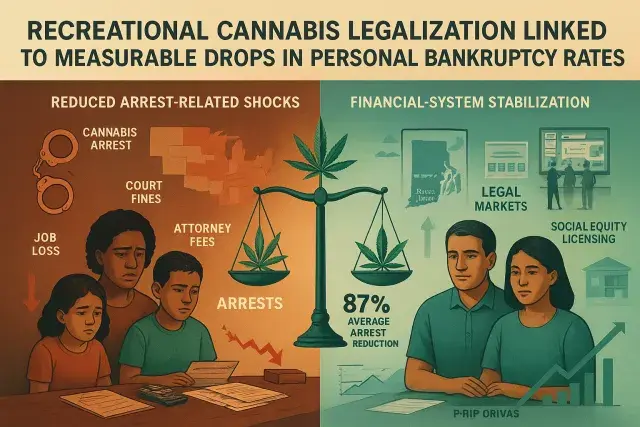
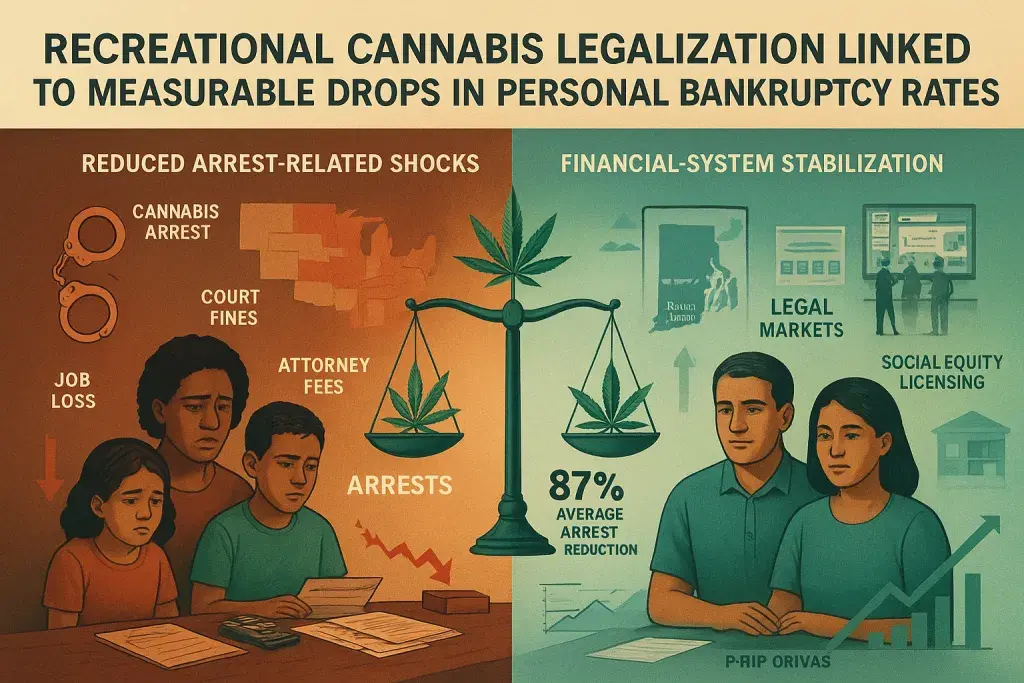
The researchers identified what they call a "legal-cost mechanism": adult-use legalization sharply reduces cannabis arrests, and states where arrest numbers fell the most also recorded the largest declines in personal bankruptcy rates. The average post-legalization arrest reduction across the states examined was 87 percent - without any corresponding increase in broader crime rates, a point the authors specifically flag to address the concern that reduced enforcement simply displaces criminal activity elsewhere. For licensed cannabis operators and the compliance technology vendors who serve them - including providers offering dispensary software in Rhode Island and other regulated markets - this finding reframes legalization's economic argument in concrete, household-level terms that go well beyond tax receipts and license fee projections.
The logic is straightforward. A cannabis arrest - even a misdemeanor - can trigger a cascade of financial consequences: court fines, attorney fees, potential job loss or suspended professional licenses, restricted access to rental housing, and, in many cases, barriers to banking. For households already operating with thin margins, that cascade can end in bankruptcy court. Legalization doesn't just create a regulated retail market; it eliminates a class of criminal justice costs that were functioning as an unpredictable and regressive tax on low-income households. The study found the bankruptcy-reduction effect was more pronounced in economically stable states - those with lower baseline unemployment, lower pre-existing bankruptcy rates, and higher median household incomes - which suggests that when the legal-cost shock is removed, households in more stable environments have enough financial runway to recover rather than collapse.
What This Means Beyond the Policy Debate
For cannabis business operators, this study adds a dimension to the legalization argument that doesn't often get traction in regulatory hearings or investment decks. The industry's standard economic case rests on tax revenue, job creation, and market size projections. Those are real and defensible. But the bankruptcy data points to something more granular: legalization can function as a form of financial-system stabilization for communities that carry disproportionate shares of enforcement costs under prohibition. That's a meaningful data point for social equity license applicants, municipal regulators weighing local zoning approvals, and MSO government-affairs teams making the case for expansion into new states.
The 2020 study the researchers reference in parallel is also worth revisiting here. That University of Iowa analysis - covering nearly 10,000 corporations between 1991 and 2017 - found that firms headquartered in cannabis-legalizing states showed higher market valuations, stronger employee productivity metrics, and increased innovation outputs following the enactment of medical cannabis laws. Taken together, the two bodies of research suggest that regulated cannabis markets create ripple effects across multiple layers of an economy: at the household balance sheet, at the small-business level, and at the corporate level. None of that is captured by excise tax receipts alone.
The Compliance Side of the Picture
Here's the catch: none of this economic benefit arrives automatically, and it doesn't arrive cleanly. A state that legalizes adult-use cannabis still has to build - and sustain - a functional regulatory framework. Licensing timelines, lab testing requirements, seed-to-sale tracking mandates, compliant packaging standards, 280E tax exposure for federally non-recognized businesses, and restricted payment infrastructure all remain operational realities for licensed retailers, regardless of what the bankruptcy data shows. The transition from a criminalized market to a compliant one creates its own category of financial pressure on operators, particularly small and independent dispensaries that lack the capital reserves of multi-state operators.
What's striking here is that the same households who benefit most from reduced arrest exposure are often the same communities that face the highest barriers to entering the licensed market as owners or employees - a gap that social equity licensing programs are designed to address, with mixed results depending on state implementation. The financial stabilization effect documented in this research is real, but it will be unevenly distributed if the licensed industry that replaces criminalized markets remains inaccessible to the communities that bore the highest enforcement burden under prohibition. That's a compliance and licensing design issue, not just a talking point. Regulators in newly legalizing states would do well to hold both findings in mind simultaneously.