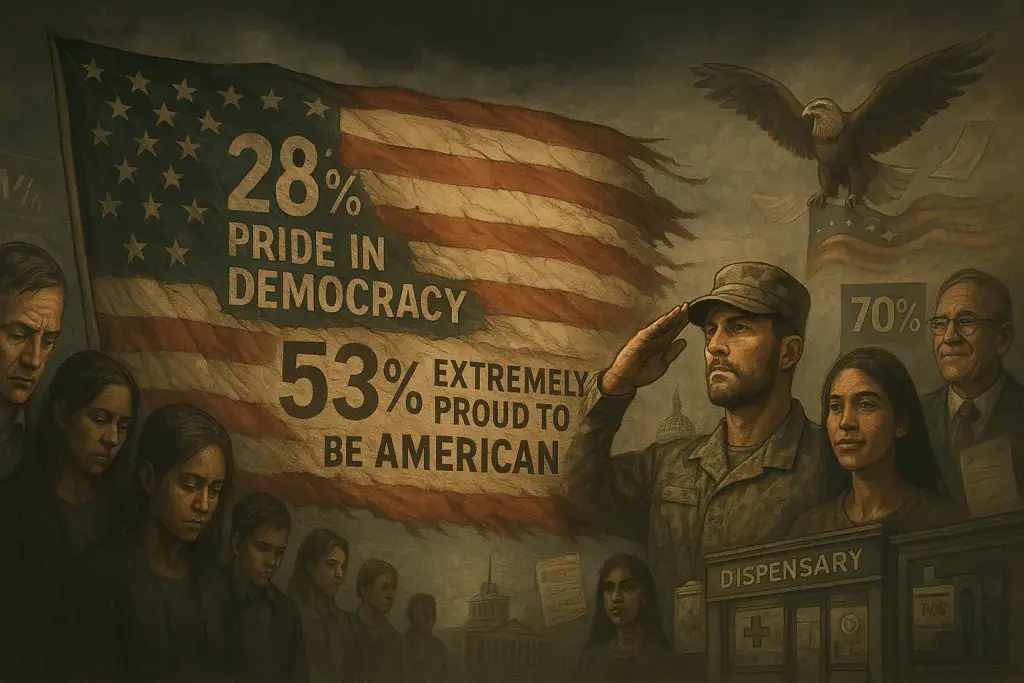
A decade of political turbulence, a global pandemic, and sustained economic pressure have collectively worn down how Americans feel about their country - and new polling data puts hard numbers to that erosion. According to a new AP-NORC survey, pride in the way U.S. democracy functions has fallen 14 percentage points since early 2017, dropping to just 28% today. Gallup's concurrent findings show that only 53% of U.S. adults now describe themselves as "extremely" or "very" proud to be American - the lowest reading in that trend since 2001.
For businesses operating within highly regulated industries - including licensed cannabis retailers, where compliance with state and local authority depends directly on the stability and credibility of regulatory institutions - shifting public confidence in democratic governance is not merely a cultural observation. It carries operational weight. When regulators face political instability or institutional distrust, enforcement priorities shift, licensing timelines stretch, and the rules that govern everything from seed-to-sale tracking to compliant packaging can change faster than operators can adapt. Dispensary owners who rely on tools like IndicaOnline cannabis POS to maintain compliance logs, manage inventory, and meet state reporting requirements understand better than most how dependent their daily operations are on the consistency of regulatory frameworks - frameworks that themselves rest on functional democratic institutions.
Where the Decline Is Sharpest - and Why It's Not Uniform
The AP-NORC data draws a clear fault line. Democrats are driving the bulk of the decline. Only 14% of Democrats say they are "extremely" proud to be American, according to Gallup, compared with 70% of Republicans. Independents sit at 28%. Pride in the U.S. armed forces has dropped 19 points since 2017 - the steepest single-category decline in the survey - with the drop concentrated among Democrats and, to a lesser extent, independents.
Republicans, by contrast, remain significantly more attached to national identity markers. About nine in ten Republicans express strong pride in the military, compared with roughly six in ten U.S. adults overall. And for Republicans, being an American is far more central to personal identity than it is for Democrats or independents. That divergence isn't just a cultural footnote - in regulated industries where licensing, social equity provisions, and enforcement discretion are all subject to political winds, the depth of partisan identity shapes what policies survive, which communities get licenses, and how aggressively violations are pursued.
Identity Beyond National Labels
The poll surfaces something else worth attention: for many Black Americans, racial or ethnic identity outweighs national identity as a defining personal attribute. Seventy-three percent of Black Americans say their race or ethnicity is "extremely" or "very" important to how they see themselves - a figure that exceeds the share identifying strongly with being American. About half of Hispanic Americans say the same about their racial or ethnic identity, compared with 22% of white Americans.
In cannabis policy terms, this matters. Social equity licensing programs - designed to address the documented disproportionate impact of drug enforcement on Black and Hispanic communities - depend on political will and institutional follow-through. When the communities those programs are meant to serve feel less invested in the national institutions administering them, and when regulatory agencies are themselves buffeted by partisan instability, the gap between policy intent and actual outcome widens. That's a real operational and moral risk for the licensed cannabis industry, which has staked part of its public legitimacy on the social equity promise.
What Endures Beneath the Discontent
Here's what the data doesn't say: it doesn't say Americans have stopped caring. Most U.S. adults still say being American is "extremely" or "very" important to their personal identity - even as pride in specific institutions erodes. The distinction matters. Pride in how democracy works is not the same as abandonment of American identity. One is an assessment of institutions; the other is something closer to belonging.
Younger Americans, though, show a notable divergence from older cohorts. About three-quarters of Americans 60 and older say national identity is highly important to them personally. Among adults under 30, that figure drops to roughly one-third. For any regulated industry - cannabis included - that generational gap in institutional attachment shapes the workforce, the regulatory advocacy pipeline, and the consumer base simultaneously. The question isn't whether patriotic sentiment has a floor. It's whether the institutions Americans are losing pride in can rebuild trust before that floor drops further.