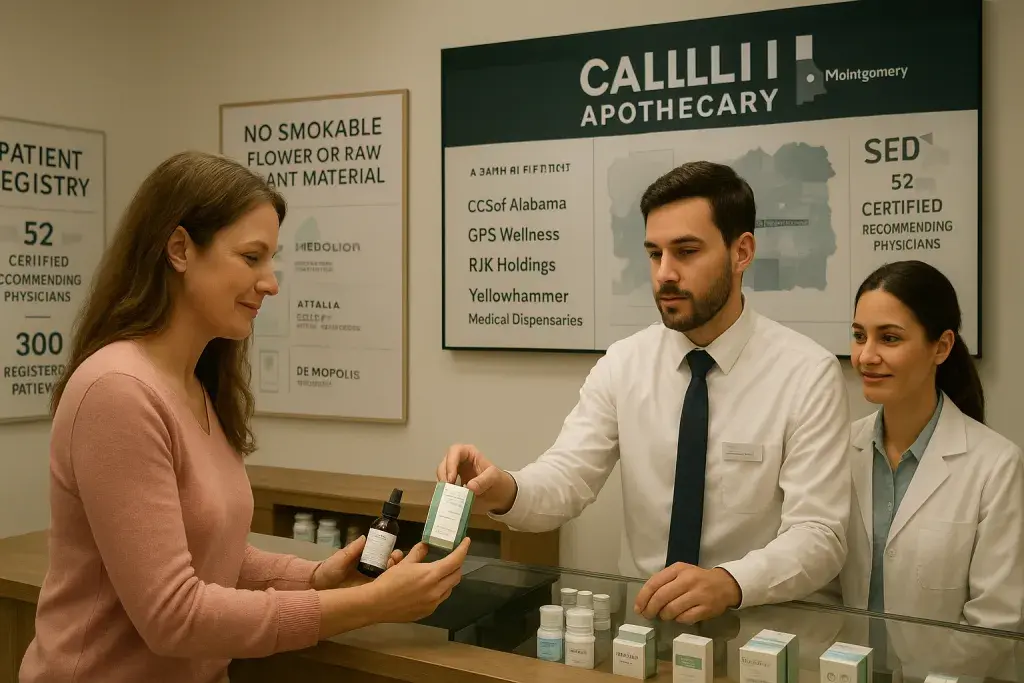
Alabama's medical cannabis program made its first retail sale Wednesday morning at Callie's Apothecary in Montgomery - a moment that took more than three years to arrive after the state legislature passed its medical cannabis law in 2021. Amanda Taylor, a patient advocate with multiple sclerosis who spent years working in Arizona's cannabis industry before returning home, purchased a water-soluble tincture and peach-flavored gel cubes, becoming the program's first registered patient to complete a retail transaction in the state.
For dispensary operators and compliance professionals watching Alabama's rollout, the program's structure tells you a great deal about how politically cautious states build regulated cannabis retail from scratch. Approved product forms are limited to tablets, tinctures, patches, oils, and gel cubes - smokable flower and raw plant material are entirely prohibited. That kind of statutory product restriction reshapes the entire supply chain: cultivators, processors, and dispensaries must align their menus to a narrow SKU set, with no room for the pre-roll or whole-flower categories that drive significant volume in more mature markets. Operators building inventory management workflows in newer state programs - whether using dispensary pos software new york or tools built for the Southeast - are increasingly having to configure product-type restrictions at the point-of-sale level to stay compliant, a reminder that platform flexibility matters as much as feature depth when programs differ this sharply by state.
The path to Wednesday's opening was anything but direct. Litigation tied up the licensing process for years - several firms challenged the Alabama Medical Cannabis Commission over its license awards, alleging a discriminatory selection process. A separate lawsuit brought by five parents seeking faster patient access was dismissed in August. Those delays compressed the window between program authorization and first sale into something operators in other states rarely experience at this scale. As of Wednesday, the AMCC had more than 300 patients on its registry, and only 52 physicians certified to recommend cannabis - a physician participation rate that will likely remain the binding constraint on patient enrollment in the program's early months, regardless of how many storefronts open.
A Four-Company Market With Narrow Geographic Coverage
When fully operational, Alabama's dispensary footprint will consist of 12 locations spread across four licensed companies. Three of those companies - CCS of Alabama, LLC; GP6 Wellness, LLC; and RJK Holdings, LLC - hold active licenses and are expected to open storefronts this summer, according to AMCC Director John McMillan. A fourth license, likely to go to Yellowhammer Medical Dispensaries, LLC, remains pending litigation. The geographic distribution covers urban centers like Birmingham, Montgomery, and Mobile, alongside smaller markets including Attalla, Demopolis, and Owens Cross Roads.
That's a deliberately constrained market structure. Twelve dispensaries serving a state of roughly five million people - with a patient registry that currently sits in the hundreds - reflects the legislature's intent to control rollout pace rather than maximize access. For the licensed operators, that means each location carries significant revenue responsibility within a low-volume launch period. The economics of a regulated medical-only dispensary in a new state program are rarely forgiving in year one: compliance infrastructure, seed-to-sale tracking requirements, staff training, and regulatory reporting all represent fixed costs that don't shrink because the patient registry is still small.
What the Physician Bottleneck Means for Retail Volume
Here's the operational reality that dispensary managers in Alabama need to plan around: 52 certified recommending physicians is a thin referral network for a statewide program. Patients cannot simply walk into a dispensary - they must obtain a physician recommendation and enter the state patient registry before any retail transaction can occur. That two-step access requirement, which is standard in medical cannabis programs, creates a patient acquisition funnel that dispensaries do not control. Unlike adult-use retail where foot traffic and impulse purchase behavior are real drivers, medical dispensaries are entirely dependent on physician engagement and patient enrollment rates.
McMillan acknowledged this dynamic directly, noting that physician participation would likely increase now that patients can actually obtain products. That's a reasonable expectation - physicians who were reluctant to recommend a product that wasn't available have less reason to hesitate once a functioning supply chain exists. But the ramp-up will take time, and operators should expect a slow initial build in transaction volume rather than a surge at opening.
The Broader Signal for Restricted-Access State Programs
Alabama's opening is a useful data point for the B2B side of the cannabis industry - manufacturers, extractors, packaging vendors, compliance software providers, and payment processors all looking at states where medical programs are still in early infrastructure stages. The product restrictions matter commercially. A program that prohibits flower and pre-rolls and permits only five dosage forms creates a very specific wholesale menu requirement. Processors targeting Alabama's market must meet those specifications exactly; there's no flexibility at the retail counter if a product form isn't statutorily approved.
Taylor drove more than two hours from Cullman to reach Callie's Apothecary - a detail that speaks plainly to the access problem that 12 dispensaries across a large state will not fully solve, at least not immediately. For now, the program is operational. Whether the physician network expands quickly enough, whether litigation resolves the fourth license, and whether patient enrollment scales to a level that makes each dispensary commercially sustainable - those are the questions Alabama's operators will be living with for the next 12 to 18 months.